Category: eLearning

Best LMS Tools of 2025: Features, Pricing & Comparison 

As businesses continue to embrace digital transformation, selecting the best learning management system (LMS) has become more crucial than ever. A powerful LMS enables organizations to streamline training, enhance employee engagement, and improve knowledge retention. In 2025, the LMS landscape has evolved with cutting-edge features such as AI-driven learning, robust integrations, and customizable eLearning solutions. This blog explores the top LMS tools of 2025, providing a detailed comparison of their features, pricing, and key differentiators to help businesses make an informed choice. Key Features to Look for in an LMS When choosing an LMS, it’s essential to consider key features that enhance training effectiveness, ease of use, and scalability: User-Friendly Interface – A well-designed, intuitive interface ensures seamless navigation for learners and administrators, improving user experience and adoption rates. Customization & Branding – Businesses can tailor the LMS with custom themes, logos, and content to reflect their brand identity and meet specific training needs. AI-Powered Learning – Advanced AI features provide personalized learning paths, automated recommendations, and performance insights to optimize training. Integration Capabilities – The ability to connect with HRMS, CRM, and analytics platforms allows organizations to streamline data flow and training processes. Mobile Learning & Accessibility – Cloud-based LMS platforms with mobile support enable learners to access content anytime, anywhere, promoting flexible learning. Robust Reporting & Analytics – Comprehensive dashboards and data analytics help track learner progress, measure course effectiveness, and drive data-driven decisions. Gamification & Engagement Tools – Features like badges, leaderboards, and interactive elements enhance learner motivation and participation. Compliance & Certification Management – Businesses can track regulatory compliance, assign mandatory training, and generate certifications to ensure workforce readiness. Content Authoring Tools – Built-in or integrated authoring tools allow organizations to create, modify, and customize training content effortlessly. Scalability & Cloud Hosting – A scalable LMS ensures growth with business needs, while cloud hosting enhances security and accessibility. Best LMS Tools of 2025: Features & Pricing Breakdown KREDO LMS Overview: A feature-rich LMS offering custom eLearning solutions tailored to corporate training needs. Key Features: Pricing: Custom pricing based on business requirements. Best For: Enterprises, corporate training, and L&D teams needing a flexible and scalable LMS. Docebo Overview: A robust, AI-powered LMS designed for automation and enterprise training. Key Features: Pricing: Starts at $900/month. Best For: Large enterprises managing complex training programs. TalentLMS Overview: A cloud-based, user-friendly LMS ideal for small and mid-sized businesses. Key Features: Pricing: Starts at $69/month. Best For: Small to mid-sized businesses looking for an affordable, easy-to-use LMS. Cornerstone OnDemand Overview: A powerful enterprise LMS with performance and compliance tracking. Key Features: Pricing: Custom pricing based on enterprise needs. Best For: Large corporations focusing on compliance and workforce development. Moodle Overview: A widely used, open-source LMS with extensive customization capabilities. Key Features: Pricing: Free, with potential hosting and customization costs. Best For: Educational institutions, non-profits, and budget-conscious organizations. SAP Litmos Overview: A scalable LMS with pre-built courses and automation capabilities. Key Features: Pricing: Starts at $6/user/month. Best For: Mid-sized businesses needing automation and ready-to-use training content. Why KREDO Stands Out Among Leading LMS Platforms Among the best learning management systems in 2025, KREDO LMS stands out due to its advanced custom eLearning solutions and authoring tools. Here’s why businesses should consider KREDO: Tailored Learning Experiences – Customizable learning paths designed to align with corporate training objectives. Integrated Authoring Tools – A built-in suite that simplifies course creation without external tools. AI-Driven Analytics – Insights that help businesses optimize training and improve learner outcomes. Seamless Enterprise Integration – Connects with HRMS, CRM, and other business applications for efficient training management. Engagement & Gamification – Enhances training effectiveness with interactive and motivational elements. Who Should Choose KREDO? KREDO LMS is ideal for corporate training, L&D professionals, HR teams, and enterprises looking for a comprehensive, scalable, and AI-powered LMS. Whether an organization requires custom eLearning solutions or seamless LMS integrations, KREDO offers an all-in-one platform to enhance learning effectiveness. Conclusion & Recommendations Selecting the right LMS is essential for businesses aiming to improve employee training and productivity. In 2025, organizations have access to various top e-learning platforms, each offering unique benefits. Ultimately, KREDO LMS remains a top-rated LMS solution, providing custom eLearning solutions, integrated authoring tools, and enterprise-grade scalability. Organizations seeking an innovative and adaptive learning platform will find KREDO a strategic investment for future success. By choosing the right LMS, businesses can empower employees, streamline training programs, and drive organizational growth in 2025 and beyond. Evaluate your business needs, explore the best online learning tools, and invest in a solution that ensures long-term success.

Top 10 Features to Look for in an LMS in 2025 

In the fast-paced world of digital learning, the Learning Management System (LMS) has become the backbone of modern education and corporate training. But with so many options available, how do you find the perfect LMS for your organization in 2025? The secret lies in choosing an LMS that not only includes LMS features to improve engagement but also integrates seamlessly with existing tools, delivers advanced reporting features in LMS, and ensures LMS security features. Here’s a deep dive into the cutting-edge LMS features that will redefine learning in 2025.  1. AI-Powered Personalization: Learning That Adapts to You  Imagine an LMS that understands what you need before you even do. AI-driven personalization tailors learning paths based on user behavior, past performance, and engagement levels.  Adaptive Learning Paths: Learners receive content recommendations based on their strengths and weaknesses.  Smart Assessments: AI-driven quizzes adapt to individual knowledge levels, ensuring a customized experience.  Chatbot Tutors: On-demand AI assistants answer questions in real-time, eliminating roadblocks.  🔹 Why It Matters? AI-driven learning ensures that every learner’s experience is unique, keeping them engaged and motivated.  2. Gamification: Turning Learning into a Fun Challenge  Engagement is the biggest challenge in e-learning. The solution? Gamification!  Leaderboards & Badges: Encourage friendly competition with real-time rankings.  Quests & Challenges: Reward learners for completing modules with interactive missions.  Instant Feedback: Make learning addictive with real-time rewards and achievements.  🔹 Why It Matters? Gamified learning transforms education into an immersive adventure, leading to higher knowledge retention and engagement.  3. LMS Integration with Other Tools: Seamless Workflows  A modern LMS shouldn’t exist in isolation. It must include LMS integration with other tools to create a user-friendly LMS platform that streamlines learning operations.  HRIS Integration: Sync employee training records with human resource databases.  Slack & Teams Connectivity: Deliver microlearning directly within workplace collaboration tools.  E-commerce Plugins: Monetize courses by integrating payment gateways.  🔹 Why It Matters? An LMS that connects with everyday tools makes learning effortless and reduces administrative overhead.  4. Mobile-First Learning: Training Anytime, Anywhere  In 2025, learning should be as easy as scrolling through social media. LMS mobile accessibility is non-negotiable.  Responsive Design: Works seamlessly across smartphones, tablets, and desktops.  Offline Mode: Download content and learn without an internet connection.  Microlearning Modules: Bite-sized learning for busy professionals.  🔹 Why It Matters? LMS mobile accessibility ensures that training happens on-the-go, boosting engagement and course completion rates.  5. Advanced Reporting Features: Data-Driven Decision Making  Numbers don’t lie, and a powerful LMS should offer deep insights into learner performance and engagement.  Real-Time Dashboards: Track progress at a glance.  Predictive Analytics: AI forecasts learning trends and potential drop-offs.  Custom Reports: Generate detailed reports tailored to your organization’s needs.  🔹 Why It Matters? Advanced reporting features in LMS help identify gaps, measure success, and optimize learning strategies.  6. Enhanced Security & Compliance: Protecting Learner Data  Cybersecurity threats are evolving, and your LMS should be ready to tackle them head-on. LMS security features ensure data protection and compliance.  Multi-Factor Authentication (MFA): Extra layers of security prevent unauthorized access.  Data Encryption: Protects sensitive learner data from breaches.  Compliance with GDPR, CCPA & ISO Standards: Ensures global data privacy adherence.  🔹 Why It Matters? LMS security features safeguard user data, build trust, and ensure compliance with legal standards.  7. Social Learning & Community Building  Learning should never be a solo journey. The best user-friendly LMS platforms in 2025 will encourage social learning and collaboration.  Discussion Forums & Peer Learning: Learners can engage, ask questions, and share insights.  Mentorship Features: Connect new learners with experienced mentors.  User-Generated Content: Allow learners to contribute and share resources.  🔹 Why It Matters? Social learning creates a sense of community, increases engagement, and enhances knowledge retention.  8. Immersive Learning: VR & AR-Powered Training  Why read about a process when you can experience it? Immersive learning via Virtual Reality (VR) and Augmented Reality (AR) is set to revolutionize LMS platforms.  Virtual Simulations: Train employees in realistic, risk-free environments.  AR Overlays: Enhance real-world learning with interactive elements.  360° Learning Experiences: Make online courses feel tangible and interactive.  🔹 Why It Matters? VR and AR take training beyond the screen, making it interactive, memorable, and highly effective.  9. Multi-Language Support & AI Translation In today’s global workforce, learning materials must be accessible to diverse audiences.  AI-Powered Translations: Instantly convert course materials into multiple languages.  Speech-to-Text & Closed Captions: Ensure accessibility for all learners.  Localized Content Customization: Adapt content for different cultural contexts.  🔹 Why It Matters? Multi-language support ensures that learning is inclusive, accessible, and effective across global teams.  10. Scalability & Customization: Future-Proof Your LMS  Your LMS should grow with your organization.  Modular Design: Add features as needed without system downtime.  Custom Branding: Ensure the LMS reflects your organization’s identity.  Multi-Tenant Architecture: Manage multiple learning environments from a single platform.  🔹 Why It Matters? A scalable, customizable LMS means you won’t need to switch platforms as your needs evolve.  Final Thoughts  Choosing the right LMS in 2025 isn’t just about ticking off a list of features—it’s about finding a dynamic, adaptable, and engaging platform that meets the needs of modern learners. From AI-driven personalization to LMS mobile accessibility, gamification, and immersive experiences, the best user-friendly LMS platforms will empower organizations to deliver high-impact learning like never before.   Is your LMS future-ready? Don’t settle for outdated training methods—embrace the next generation of e-learning

LMS vs. Traditional Learning: Which One is Better?

Education and training have come a long way, evolving from old-school chalkboards to digital dashboards. With the rise of Learning Management Systems (LMS), the debate over LMS vs Traditional Learning is hotter than ever or how is LMS different from traditional way of training and learning and which one is better? The truth is—it depends on what you’re looking for! Let’s break it down and compare Traditional Classroom Learning vs Online Learning to see which one wins the battle.  The Face-Off: Traditional Learning vs. LMS  1. Flexibility & Convenience – Learning Anytime, Anywhere  🔹 Winner: LMS! Flexibility is key in today’s fast-paced world.  2. Cost – Is It Breaking the Bank? 🔹 Winner: LMS! The benefits of Learning Management Systems include lower costs and greater accessibility.  3. Engagement – Keeping Learners Hooked  🔹 Winner: LMS! One of the advantages of LMS over traditional methods is how it makes learning more fun and engaging.  4. Tracking & Progress Reports – Who’s Really Learning?  🔹 Winner: LMS! Data-driven learning is the future.  5. Scalability – One Course, Thousands of Learners  🔹 Winner: LMS! Digital learning grows with your needs.  6. Security & Compliance – Keeping Data Safe  🔹 Winner: LMS! Security matters, and digital platforms have the upper hand.  But Wait—What About Traditional Learning?  Before we crown LMS as the ultimate champion, let’s not forget the Traditional Learning Methods vs Modern Learning Systems debate isn’t one-sided. There are some things traditional learning does well:  Face-to-face interaction: Nothing beats human connection and live discussions. Immediate feedback: Ask a question, get an answer on the spot. Structured learning: Fixed schedules and discipline can work well for some learners.  However, Traditional Education Challenges—like inflexibility, high costs, and lack of accessibility—make it hard to keep up with modern learning demands.  eLearning vs Traditional Education: The Verdict?  Both have their strengths, but in today’s digital world, LMS wins for accessibility, engagement, and scalability. That doesn’t mean traditional learning is obsolete—blended learning (a mix of both) might just be the perfect solution.  Final Takeaway: If you value convenience, cost-effectiveness, and engagement, digital learning vs traditional learning isn’t even a debate—LMS is the future!  So, which side are you on? Team LMS or Team Traditional Learning? Let us know in the comments! 

Boosting Learner Engagement: Enhancing Skills-Based Learning and Collaboration

Introduction In today’s rapidly evolving work environment, skills-based learning has become essential for both organizations and individuals. With technologies advancing, the shelf-life of skills continues to shrink, making ongoing training critical. A growing number of learning platforms are designed to meet these demands, and KREDO stands out in providing a seamless, learner-centric approach that integrates skills development and collaboration. In this blog, we will look at how organizations can leverage KREDOto enhance engagement, optimize skills-based learning, and foster a collaborative learning culture. KREDO helps move away from the focus on knowledge-based learning to a combination of the same and skill-based learning. 1. Personalizing Learning Paths for Skills Development One of the fundamental ways to drive learner engagement is through personalized learning paths. By tailoring the learning journey to individual needs, learners are more likely to stay engaged and motivated. KREDO enables organizations to create customized learning experiences by identifying the skills each learner needs to acquire or improve upon. 2. Gamified Learning for Better Engagement 3. Social Learning and Collaboration In a digital learning ecosystem, collaboration plays a significant role in keeping learners connected and motivated. KREDOenhances collaborative learning through its interactive social features. These features allow learners to share insights, ask questions, and solve problems together, making learning a communal activity rather than an isolated task. 4. Content Curation and Microlearning Modern learners seek flexibility. With time constraints and competing priorities, the bite-sized learning model, or microlearning, proves highly effective. KREDO excels at curating content in smaller, digestible chunks, making it ideal for skills-based learning. 5. Analytics-Driven Learning for Continuous learning as well as Improvement Data-driven insights are essential to enhance both learner performance and organizational outcomes. KREDO  provides detailed analytics and reports, allowing organizations to monitor the effectiveness of their training programs and adjust accordingly. 6. Seamless Integration with Existing Systems To maximize the effectiveness of skills-based learning, it’s crucial that learning platforms integrate smoothly with existing corporate systems. KREDO offers seamless integration with HR systems, performance management tools, skills-competency engines, and external content providers. Conclusion As organizations continue to face new challenges in skill acquisition and workforce development, KREDO offers a powerful solution. Through its personalized learning paths, gamified experiences, collaboration features, and data-driven insights, it fosters both learner engagement and skills development. By leveraging this platform, organizations can build a more capable, future-ready workforce while ensuring that learning remains engaging and impactful. At Tesseract Learning, our learning architects and visual architects continuously innovate and reinvent their approaches to design, develop, and deliver better learning experiences. Skills-based learning encourages active learning facilitating immersion and other hands-on experiences. The concept of career readiness becomes a reality. And finally, skills mastery is no more a dream of the future but it becomes ingrained as a daily habitual task. To experience KREDO in action, schedule a free demo or contact us to know more!

Where Learning Meets Networking: Reasons for Using Social Media in eLearning

Introduction The training professionals are using social media platforms to share knowledge and course materials in real time. Learners connect with peers and trainers to discuss concepts, clarify doubts, seek more information, or share their experiences. Social media fosters peer-to-peer, collaborative learning and promotes learning practices. As per Deloitte’s 2023 Global Human Capital Trends, 77% of businesses are incorporating social and collaborative tools in their corporate learning strategies. The Corporate Learning Network 2023 survey shows that 68% of organizations are already using social media as a part of their training. So, eLearning has jumped on the social media bandwagon. #eLearning Given the fact that social media can be an empowering tool, many organizations are keen on using a learning management system (LMS) with in-built social media. Let’s see some interesting stories about the same.  Accelerates Sharing of Knowledge After closing a difficult deal, a salesperson posts the success story and shares the strategy and techniques used. Globally, sales team members join the conversation, ask questions, and discuss how to apply these strategies to different clients. Strong Network of Support A new manager is struggling with a team issue and decides to take advice from colleagues. He posts a question on the LMS social media, and colleagues from various locations offer advice and encouragement. This network of support not only enhances learning but also fosters stronger interdepartmental relationships. User-Generated Content All the store managers are assigned a visual merchandising eLearning course. After the course completion, some employees post pictures of store layouts that they have designed highlighting, which has worked well. Few others share tips on product placement and color schemes. The management appreciates the engagement and decides to incorporate these inputs in the subsequent courses on the same topic.  These layouts and tips become input for reference for all. Most of them are added as resources in the LMS. Get to Know Learners’ Preference Employees enrolled for a new eLearning course in Agile Project Management. They utilized the LMS’s social media integration to share their thoughts, ask questions, and provide feedback on various topics. The training team tracked the discussions to identify areas where employees felt less confident or needed more resources. Continuous Learning Culture In a manufacturing company, the safety department uses an LMS with built-in social media to run mandatory safety training courses at regular intervals. Workers are allowed to share the hazards they faced and the measures they took. Various near misses are discussed, and safety protocols are shared even after the course is completed. This reinforces safe practices and helps maintain a proactive, continuous learning environment focused on workplace safety. Engagement Through Competition LMS social media is accessible anytime and anywhere. Learners can engage from any device instantly or at their convenience. Learning management systems have leaderboards that allot scores for engagement with learning assets as well as discussion forums and in-built social media. This drives employees to contribute their knowledge and seek guidance as and when. With social media meaningful engagement, learners can push their scores up on LMS leaderboards. Social media lets every employee be a learner as well as a teacher or subject matter expert. Conclusion Social media has become a powerful tool for companies to drive learning outcomes. We have incorporated several aspects of social media in our learning management system, KREDO. It has built-in discussion boards where a learner can share insights, ask questions, discuss, and collaborate. Any employee can raise a request to become a trainer for upcoming webinars that can be hosted on KREDO itself. Interestingly, every engagement in the LMS, including the discussion boards, gets the learners points on the leaderboard. This is just the tip of the iceberg. Engage, compete, collaborate, and learn. We at Tesseract Learning help your organization move with the times and stay ahead of the curve with our technological innovations. The mobile-friendly KREDO LMS has won accolades and awards in the past 3 years, including the coveted Brandon Hall Group Gold Award 2024 for excellence in various categories. To explore the KREDO Learning management system, book a free demo or write to us at <suresh@tesseractlearning.com>

Empowering Health Education for a Sustainable Future, KREDO eLearning Platform for SDG 3

Introduction Sustainable Development Goal 3 aims at ensuring healthy lives and promoting well-being for all. From non-communicable lifestyle diseases to pandemics, there is not a single person who has not been affected by health woes. Some of the focus areas of SDG 3 include: • Increase universal health coverage • Increase childhood immunization • Reduce maternal and child mortality • Prevent, control, and eradicate Neglected Tropical Diseases (NTDs) such as malaria, TB, etc.   • Reduce the mortality rate from noncommunicable and communicable diseases • Improve mental health and wellbeing • Mitigate the impact of health emergencies such as pandemics and natural disasters The implementation of SDG comes with its own set of challenges. The lack of skilled health professionals is one of the key issues faced while enforcing sustainable development measures. The other major hurdles are lack of funding, poor regulation, economic inequality, gender bias, and regional disparities. Health Workers the Heart Beat of SDG 3 Health workers play a critical role in attaining the SDG 3 targets. The health workers not only save lives, but they also support socio-economic development. As they work to enhance health outcomes, they become instruments in the advancement of human rights, accountability, collaborative partnerships, and innovative approaches. Health workers include physicians/surgeons connected to medicine, dentists, nurses, pharmacists, as well as allied health professionals (AHPs). AHPs are individuals with qualifications and competence in therapeutic, diagnostic, curative, preventive, and/or rehabilitative interventions. The range of auxiliary activities in healthcare includes physiotherapists, occupational therapists, laboratory technicians, radiology technicians, medical and non-medical technicians, clinical technicians, caregivers, therapists, audiologists, community health workers, healers, traditional medicine practitioners, and so on. There is no other alternative to health workers, and a learning management system (LMS) can be the lifeline to train, retain, and build a robust network of health professionals across the globe, especially in remote areas. eLearning for SDG 3 eLearning can help in the development, training, and retention of the health workforce, especially in the least developed countries and island states. ‘Factors Influencing the Effectiveness of E-Learning in Healthcare: A Fuzzy ANP Study’ was published in 2023 in Healthcare (Basel). As per the study, some of the benefits of eLearning in healthcare include increased accessibility, interactivity, flexibility, knowledge management, and cost efficiency. There was another study published in 2021 in Infect Dis Poverty. ‘The effectiveness of E-learning in continuing medical education for tuberculosis health workers: a quasi-experiment from China’. In this experiment, clinicians and primary care workers benefitted from eLearning activities. Let’s see how the KREDO learning management system can help health workers in reaching their goals of providing healthcare access to all. Accessibility eLearning platforms can transcend geographical boundaries and provide course access to health professionals in the remotest corners of the world. These self-paced courses can be taken at their convenience without disturbing their workflow. KREDO Learning platform: The SCORM files of courses created externally can be uploaded to the learning management system KREDO. It has its own authoring tool with interactive, ready-to-use templates to churn out courses on the go. Moreover, using KREDO, eLearning courses can be created in any base language. These courses can then be translated to any language using AI. So, whether it is tuberculosis (TB) health workers in the Oti region, Papua New Guinea, Afghanistan, or Estonia – they all can receive training by going through the translation of the same course. Most health workers are locals who try to make quality health accessible to the community. All the health workers can be added as users in the LMS. The courses can be scheduled for them individually or in groups (user groups). Interactivity The eLearning courses can be made engaging using interactive templates. Additionally, webinars, classrooms, and discussion forums can enhance interaction among health workers and experts. This will bring about the much-needed sharing of information to handle regional and other challenges for the implementation of SDG 3. KREDO Learning platform: It has interactive templates both for assessments and content. Create short courses revolving around one or two learning objectives, so that it is easier for the health workers to assimilate the information. The discussion forum will let them ask queries to experts and help share their experiences to enhance each other’s capabilities. On the same platform, webinars and classrooms can be held to support collaborative learning. KREDO has wide integration with online conference tools. Its Classroom feature helps to schedule both online and offline training across the world. Yes, the learning management system helps organizations scale the training, irrespective of diversity.   Knowledge Management An agile eLearning platform will help optimize learning resources and create a level-playing field among health workers. This ensures standardization and consistency in the quality of training courses. KREDO Learning platform: All the necessary resources can be uploaded to the LMS for equal access to all. Courses, webinars, classrooms, resources, and surveys can be dragged and dropped into learning pathways to ensure seamless knowledge management. Flexibility Learning platform provides flexibility of time, space, and a library of courses to enhance the knowledge quotient of the learner. KREDO eLearning platform: It has a content hub comprising LEAP, external content, and MOOC content. LEAP refers to the Learning Essentials Achievement Program. This is a set of paid courses, certifications, and specialization tracks that have been identified from Edx, Udemy, Coursera, and many other global content and verification providers added by an LMS admin.  The LMS administrator or manager can add links to both articles and videos for further reference. MOOC content gives access to a library of free content. Conclusion As discussed, the lack of skilled health professionals is one of the key issues faced while enforcing sustainable development measures around the globe. Even with the right training, it is not easy to deliver the same in different languages at the time of requirement. A learning management system (LMS) can be the lifeline to train, retain, and build a robust network of health professionals across the globe, especially in remote areas. There is more to KREDO, and we are keen to discuss it with you…

Transform Your Remote Training with KREDO: The Ultimate Learning and Development Platform

Introduction Post-pandemic, remote working has been accepted in the corporate world to various degrees. According to WFHResearch report, 12.7% of full-time employees work from home, while 28.2% work in a hybrid model, as of 2023. An Upwork report estimates that 32.6 million Americans will work remotely by 2025. Therefore, corporate training must also aim for the cloud to empower remote employees. Well, not just metaphorically, but literally too, remote training must take the online trajectory to meet the learning goals. A dynamic learning and development (L&D) platform becomes vital for scaffolding remote training. Learning and Development Platform for Remote Workforce A transformative eLearning platform stitches all the processes required for creating an unparalleled learning experience for remote employees. Its role is not limited to the creation and management of users, and user groups, the scheduling of content delivery, and monitoring learning behavior. An efficient eLearning platform drives engagement, a critical factor for increasing the learning quotient amongst remote workforces. In addition to simple administration, KREDO learning platform has an inbuilt authoring tool, Classrooms feature, and various integrations for collaborative learning and learning paths for continuous learning of the workforce spread across various geographies. Let’s see how the KREDO learning and development platform can redefine the training of remote employees. User and User Groups for All To begin with, entire staff can be added as users to KREDO, irrespective of which location they are based out of. They can be clustered into different user groups based on their verticals, departments, professions, seniority levels, and any other differentiators. Scenario: A global food and beverage company with operations in nutrition, and wellness products can create user groups as per verticals, products, and departments to assign specific courses to that group and schedule a series of eLearning courses for each learner (2+ lakhs). Learning Pathways KREDO administrator or training manager can add customized learning pathways for each user and user group across the globe. Courses, webinars, resources, and surveys can be added in different combinations to the various learning pathways. These learning pathways can last the entire life cycle of the employees. It is endless for user groups, where different employees can be added or removed at any time. Scenario: A maritime company providing port services, ship services, and management may create several learning pathways for each of its services. It can add leadership webinars for the crew management team and simultaneously add risk management memory boosters for the risk management middle-level officers. The company has a presence in several ports around the world. Did you know?Every engagement with learning assets gets the learner some points. The greater the number of points, the higher the ranking on the leader board. eLearning Courses for the Moment of Need It is simple to add the SCORM files of online courses to the KREDO learning and development platform. Alternatively, courses and gamified assessments can be created rapidly with the inbuilt authoring tool, which has a palette of 60+ ready-to-use templates.Additionally, learners can enhance their knowledge through LEAP, or the Learning Essentials Achievement Program. It is a set of paid online courses, certifications, and specialization tracks that have been identified from Edx, Udemy, Coursera, and many other global content and verification providers. Supporting reference material can be placed in Resources, MOOC Content, or External Content. Scenario: A manufacturing company can add their previous eLearning courses to KREDO and continue to create more courses using KREDO’s authoring tool. Their learners can access paid courses from other content providers and get certification of course completion. KREDO learning platform offers a unique blend of self-paced and collaborative learning. Collaborative Learning While each remote employee can access both the assigned and open courses at their convenience, they can also learn collaboratively. Collaborative learning is vital for creating a bond amongst remote employees and for deepening engagement. Let’s look at some of the features that drive engagement. Classroom The administrator of the learning and development platform, or the training manager, can manage online and offline coaching sessions. Webinars Meetings, discussions, and training can be held on Zoom, Teams, or Google Meet on the KREDO eLearning platform itself. Discussion Forums Ask your queries, seek clarifications, suggest, or place your request for any eLearning course or asset through discussion forums on KREDO. Scenario: A food delivery company that is also engaged in grocery and courier delivery has lakhs of delivery partners. How can it manage uniform service standards and engagement across such a massive workforce? It can create weekly, monthly, etc. webinars for training and communication. The delivery partners can discuss their concerns and learn from each other’s experiences on discussion forums. Did you know?Any team member can share their knowledge learned on the job by raising the request for being a trainer. Localization eLearning courses built in KREDO can be created in any base language and translated into multiple languages swiftly in which the remote staff communicates both internally and externally. Scenario: A global automotive company has factories in more than one continent, and the shop floor staff speak different languages. The company translated all the SOPs into several languages so that it could maintain uniform quality standards across the organization. It included SOPs like assembly line setup and configuration, engine assembly and testing, material procurement, safety, welding, and metal fabrication, to name a few. Conclusion KREDO is the ultimate learning and development platform for organizations ranging from small companies to big enterprises across all industries and domains. We train our clients on the features and functionality of the KREDO eLearning platform. This includes detailed coverage of the responsibilities of an admin, author, manager, and learner. KREDO has also been recognized as ‘Easiest To Do Business With’ and ‘Fastest Implementation’ in the recent G2 spring reports 2024. KREDO has won accolades and awards in the past 3 years, including the coveted Brandon Hall Group Gold Award 2023 for excellence in “Best Advance in Learning Technology Implementation.” To explore the KREDO Learning management system, book a free demo or write to us at <suresh@tesseractlearning.com>

Steering the Auto Industry Through the Growth Highway with the Power of KREDO LMS
Introduction When it comes to training and development, every industry faces challenges, and the auto industry has its share of potholes. Let’s understand the unique challenges and contours of the auto industry and review how KREDO LMS can help circumvent these bends in the Learning and Development (L&D) journey. Concern: The vast number of trainees is spread across wide geographical locations. Classroom training sessions in all locations in offices and on factory floors for thousands of workers can be time-consuming and costly. Solution: A fast learning management system provides scalability. KREDO LMS allows the auto company to create thousands of users and segregate them into different user groups. These user groups can be based on department, task, location, training cycle, and so on. Employees across the globe can access the eLearning courses at their convenience. The biggest advantage to the organization is that they can manage course scheduling and track learner behavior in relation to the courses. Concern: The L&D goals need to cover diverse skill sets. On one side of the spectrum, there is technical training for both products and processes. On the other end, there are soft skills such as personal and business development. There cannot be one size that fits all. How do we cater to such diversity in the moment of need?  Solution: A diverse skillset means multiple learning objectives. Evolving technology requires varied skill sets. Therefore, there is a need for customized and bespoke eLearning courses. KREDO LMS has an inbuilt authoring tool that has ready-to-use engaging content and assessment templates. This helps create eLearning courses quicker, so that they are available to employees, ancillaries, suppliers, etc. on the go. However, you can provide soft skills training through off-the-shelf eLearning courses. KREDO integrates content from several content libraries from which you can curate your set of courses for different topics such as communication, leadership, time management, negotiation, and more. Concern: Employees with diverse demographics communicate in different languages. Solution: eLearning courses in KREDO LMS can be created in any language and translated into any other languages. There are options for both auto-translation and request for translation. The request for translation can be sent to the translator, who will then enter the relevant translated information. Once the course is translated, it can be sent for review. This LMS supports localization and scalability. Concern: The auto industry is highly competitive and has a high attrition rate. Solution: Continuous learning can be the spoke in the attrition wheel. A culture of learning that empowers your employees is critical for increasing their retention and creating a talent pool. KREDO learning pathways are unique to each employee and map their continuous learning journeys. Courses can be scheduled at different intervals. Any updates in the International Automotive Task Force (IATF), ISO Standards, and other safety requirements can be presented in short, bite-sized courses and added to the learning pathways as and when you want. All the users (learners) who have been allotted those eLearning courses get notifications both via email and KREDO. Concern: Access to diagrams and illustrations, 3D animations, and expert guidance may seem difficult to manage. Solution: It is not just eLearning courses, but resources, webinars, classrooms, surveys, etc. can also be included in the learning pathways. Configure a diverse range of learning assets, such as classrooms, videos, and interactive sessions, which cater to various learning modalities. Auto-related designs and recorded auto service and repair videos can be part of the learning pathways. You can integrate web conferencing tools with KREDO to make virtual instructor-led training (VILT) possible. This complements self-paced eLearning. Wondering how to manage them? You can manage online and offline coaching sessions with KREDO Classroom feature. Conclusion  There is more to KREDO, and we are keen to discuss them with you. KREDO LMS is an overpass to various learning barriers in the auto industry. Wide integrations and inbuilt capacities let KREDO accelerate your learning outcomes. The KREDO LMS is rebuilding the lanes of technological evolution in the training industry. It has won accolades and awards in the past two years, including the coveted Brandon Hall Group Gold Award 2023 for excellence in “Best Advance in Learning Technology Implementation”. To explore the KREDO Learning Management System, contact us or write to <suresh@tesseractlearning.com>

KREDO: A User-Friendly Learning Platform to Build Continuous Learning Journeys

Introduction Does learning ever stop? What do you think? In my opinion, learning always evolves, but it never comes to an end. That’s quite unimaginable. Continuous Learning is a constant expansion of skills and knowledge. What makes this form of learning a necessity? It is to ensure that the learner adapts to personal and professional changes in any environment he or she is in. KREDO is a name that’s not only for the novice but also for the expert. It is the go-to learning platform for the seasoned experts who wish to touch levels of excellence that they demand, even beyond what their organization seeks.     Creating A Culture Many organizations in today’s world have taken rapid strides and have surged ahead in embracing the culture of ‘Investing in People’. As the organization grows, they also wish for their employees to grow holistically. KREDO’s flexibility in enhancing an existing course to make it more in-depth and detailed is a feature that will hold any continuous learning journey in good stead. Right from the onboarding stage, when a new employee signs on the dotted line, their learning begins. This could be through short videos, to begin with. Every employee must know what it means to learn in the flow of work rather than considering learning a separate activity. Learning must never be imposed but must always be left to the employee by keeping it self-directed. One way to ensure this happens is by keeping the learning resource library as diverse and vivid as possible. I’ll run you through a few simple examples to make this possible in the next few lines. Being Multidirectional A new habit is not easy to cultivate, and when it comes to ‘Continuous Learning’, a thorough effort is required. How would it sound if I said that you could adopt ‘Continuous Learning’ using KREDO through various learning strategies? This practice eventually becomes a relentless good habit for everyone in your organization. ‘Continuous Learning’ differs in the formats that one wishes to choose from. Now, let’s look at why KREDO is the answer to every ‘Continuous Learning’ journey you can think of. 1. Blog posts: These combine text, videos, infographics, etc. 2. eBooks: Electronic text containing extras, like audio, video, hyperlinks, etc., ensuring proactive interaction. 3. Expert Videos: Invaluable advice, insights, views, suggestions, and more right at your fingertips. 4. Explainer Videos: Complex concepts and processes become easy to understand. 5. Infographics: Creative and visual approach to help you recall and retain information. 6. Interactive Screens: Motivation levels are kept high through interactivity, multiple clicks, and less risk. 7. Job Aids: What is the task? How do you get it done? Job aids help you with simple and clear instructions. 8. Memory Boosters: Information recall made easy – anytime, anywhere ­– in the learning journey. Deliver continuous learning to your learners to beat the learning curve and optimize their performance. 9. eLearning and Microlearning Courses: Bite-sized learning modules making learning easy, effortless, and comfortable. 10. PDFs: Another format used to upload multiple documents converted from .doc, .docx., .ppt, .pptx, etc. 11. Remediations: Fill the learning gap with the help of remediation materials to equip your learners to be more competent. 12. Webcast and Podcasts: Audio and visuals or audio alone. Feel free to choose as your learner likes it to be. 13. Webinars and Recorded Webinars: Presentations, videos, web pages, etc., watch them live or recorded. 14. Virtual Meetings: Schedule virtual meetings with your learners, via Zoom, in KREDO. 15. Tool Integration: Integrate KREDO with any learning content provider, HRMS platform, BI tools, etc. You can import SCORM packages into KREDO. Learning across any industry, be it the private sector or the government sector, is continually being disrupted through advances in technology, demographic changes, and constantly changing competitive landscapes. A better learning experience is the necessity of the hour, and continuous learning embraced through KREDO, a platform that understands these critical factors and their downstream implications, positions us well as your go-to learning platform of choice. Conclusion Through ‘Continuous Learning’, KREDO as a learning platform is all about ensuring professional competencies are managed, ensuring people stay employable and eligible for various roles, and creating a company culture where penalizing is not always the answer to mistakes that are made. But ‘Continuous Learning’ ensures employees stay up to date, thereby improving the survival capabilities in dynamic business environments. ‘Continuous Learning’ involves practice, feedback, and reflection. KREDO aids this by providing various forms of learning resources that can be accessed just in time while working. In addition, KREDO helps in rapidly re-organizing learning experiences. The ‘Continuous Learning’ journey is the approach that will move organizations from a content-centric “push” approach to a learner-centric “pull” approach. At Tesseract Learning, we’ll discuss your challenges and work with your team in understanding your business needs, learner expectations, and technology environments. If you wish to know how our services, KREDO learning platform, and Prodient.io authoring tool can help your organization in developing continuous learning journeys for your employees, write to us at <suresh@tesseractlearning.com>.

Scale your Training Programs with Fast LMS KREDO

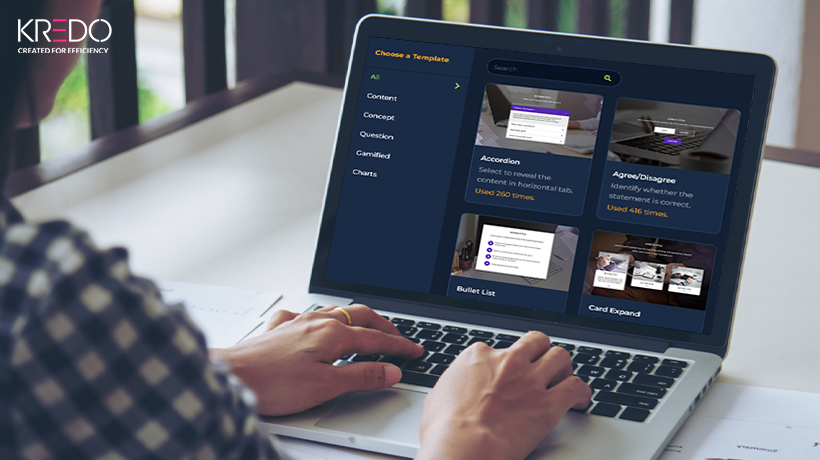
Intro Summary An effective eLearning solution enables organizations to overcome the constraints of time and distance in the training sphere. It helps to train a greater number of learners across the globe in a shorter span of time. In this article, we will cover how fast LMS KREDO empowers businesses, governments, and training institutes to scale their training programs. Introduction What exactly is understood by scaling the training program? Let’s look at a scenario. A global food and beverage company has operations in nutrition, health, and wellness products. They employ more than a lakh employee worldwide. They have manufacturing units as well as offices in multiple cities. They have huge supply chains, both as a prefix and a suffix. One of the most powerful ways to permeate uniform standards across all verticals, employees, and other stakeholders is through training. James, their training head, is looking for a highly engaging LMS that can become a chassis for the success of their training goals. Let’s see how an effective learning management system KREDO can help support and scale their training program. Users and User Groups KREDO allows organizations to individually add all their learners and categorize them into groups. User groups can be created based on different verticals, roles and responsibilities, internal and external stakeholders, languages, organizational levels, countries, and more. New learners can be added anytime. Scenario: James efficiently populates the learners’ database by exporting details in bulk from an excel sheet and organizing them into different user groups. In-built Authoring Tool KREDO LMS has an in-built authoring tool with 50+ eLearning templates to create courses for learning in the flow of work. The palette of templates helps to cater to varied learning styles: visual, auditory, reading/writing, and kinesthetic—the VARK model. Assessment templates gauge the learner’s understanding of the concept while administrators can enhance the learning experience by choosing from various color themes and configurations. Scenario: Once the learners’ details are in place, James adds SCORM files for various courses and prepares a list of courses that would be created in the LMS. Localization A large spectrum of learners presents the scope of interaction in various languages. KREDO LMS inbuilt courses can be translated into a wide range of languages.  Localization is the cornerstone of an organization’s commitment to Diversity, Equity, and Inclusion (DE&I). The Language Selector option in the settings lets the learners choose the preferred language for the course. Scenario: James intends to translate LMS courses into Spanish, German, and Arabic to start with, and then move to other languages. Learning Pathways While an inbuilt authoring tool helps shorten the duration of course creation, learning pathways help the L&D team leap into the future. The learning journey is never-ending, and learning pathways allows one to add courses endlessly. And it is not just courses- webinars, classrooms, resources, surveys, etc. can be added to the learning pathways. Yes, all these can be created on a single eLearning platform, KREDO. These capabilities support the blend of eLearning and virtual instructor-led training (VILT). Moreover, there can be multiple customized learning pathways for different users and user groups. Scenario: James creates multiple learning pathways for different countries, verticals (such as nutrition, health, etc.), and departments. He has scheduled online and offline SME sessions in Classrooms. Likewise, he will use surveys, webinars, etc., to deepen learner engagement for more teams across the world. Thus, we saw how KREDO LMS makes distance immaterial and manages time efficiently. Conclusion This is just the tip of the iceberg. There are intelligent report analytics, course presets, and wide integrations to help you scale your training programs and deepen engagement. We train our clients on the features and functionality of the KREDO eLearning platform in 2–3 business days. This includes detailed coverage of the responsibilities of an admin, author, manager, and learner. The KREDO eLearning Platform is rewriting the chapters of technological evolution in the learning industry. It has won accolades and awards in the past 3 years, including the coveted Brandon Hall Group Gold Award 2023 for excellence in “Best Advance in Learning Technology Implementation”. To explore the KREDO Learning management system, book a free demo or write to us at <suresh@tesseractlearning.com>